Microplastics in Tea Bags: UK Brands Compared
Tea is the UK’s national drink — the UK Tea & Infusions Association puts it at roughly 100 million cups a day, almost 36 billion a year. So when research showed that many tea bags shed plastic particles into hot water, it touched almost every household in the country. Several years on, the brands have moved — but not as far as the “plastic-free” labels suggest.
This is an honest 2026 status check: what the research really found (including the parts that are disputed), where each major UK brand actually stands today, and why “plant-based” is not the same as “plastic-free”.
The Research — and What Is Actually Settled
The headline figure, and why it’s contested
The number everyone quotes comes from a 2019 McGill University study in Environmental Science & Technology, which found that a single plastic pyramid tea bag brewed at 95°C released approximately 11.6 billion microplastic and 3.1 billion nanoplastic particles into one cup. The bags tested were nylon and PET (polyethylene terephthalate) mesh.
It is worth being straight about this figure, because most articles are not. It was challenged. A 2020 comment in the same journal by Busse and colleagues argued that a large share of what was counted were dissolved oligomers and other leachables — not solid microplastic particles — and their own measurements found microplastic counts around two orders of magnitude lower. Germany’s Federal Institute for Risk Assessment (BfR) reviewed the exchange and concluded the original authors’ response did not adequately address the criticism. The McGill team, for their part, defended their method, noting they deliberately avoided pre-filtering samples to prevent particle loss.
So the precise “billions per cup” number should be treated with caution. It is probably an overestimate of true solid microplastics.
What has held up
What has not been overturned is the underlying finding: plastic-containing bags shed plastic into hot water, in large quantities.
The strongest recent evidence is a 2024 study in Chemosphere from the Autonomous University of Barcelona, which characterised particles released from commercial tea bags of different materials. It found:
- Polypropylene bags released around 1.2 billion particles per millilitre, averaging 137 nanometres.
- Cellulose bags released around 135 million particles per millilitre (244 nm).
- Nylon-6 bags released around 8.18 million particles per millilitre (138 nm).
The researchers then exposed human intestinal cells to the particles and observed uptake, with some particles reaching the cell nucleus — the first direct look at how these particles interact with gut tissue. The health implications of that are still being studied, and we cover the wider question of whether microplastics affect human health separately.
The takeaway: ignore the exact headline count, but take the direction seriously. Pouring near-boiling water through plastic mesh releases a great many plastic particles.
Which UK Brands Still Use Plastic — 2026 Status
Traditionally, most UK “paper” tea bags were sealed with a strip of polypropylene — an oil-based plastic making up roughly 20–30% of the bag — to heat-seal the edges. That strip is why old-style bags never fully composted. Under consumer pressure, brands have been replacing it. Here is where the major names actually stand, based on their own current statements.
Genuinely plastic-free
- Pukka — the cleanest position. Pukka’s bags are stitched with a simple fold and organic, non-GMO cotton, with no staples, no glue, and no polypropylene. The bag paper is a blend of abaca (a banana-plant fibre), wood pulp, and plant cellulose. Pukka says it was the first company to stitch teabags with organic string rather than heat-sealing them with plastic. Genuinely plastic-free and home-compostable.
Switched to plant-based PLA (a bioplastic, not “no plastic”)
- Yorkshire Tea — its regular UK bags are now plant-based: most of the bag is natural fibres (wood pulp), and the seal is PLA, an industrially compostable, plant-based plastic. Notably, Yorkshire Tea is careful not to call these “plastic-free”, stating plainly that “plant-based plastics are still plastics.” Its speciality and catering bags are still around 75% natural fibre with a 25% polypropylene seal, mid-transition to PLA. Dispose of the PLA bags in a kerbside food or garden waste bin, not a home compost heap.
- Clipper — in 2018 became the first UK brand to make all its heat-sealed bags unbleached, non-GM, plant-based and biodegradable, using a PLA seal made from plant cellulose. Like Yorkshire Tea, Clipper dropped the “plastic-free” wording around 2020, now describing the bags as plant-based and biodegradable rather than plastic-free.
- PG Tips — has transitioned its bags, including its pyramid bags, to a plant-based, biodegradable material (cornstarch-derived PLA and natural fibres), replacing the original polypropylene. PG Tips bags can go in a food waste caddy or home compost, though PLA breaks down slowly in a cold home heap.
Transitioning — check the specific pack
- Tetley — a genuinely mixed range. Traditional Tetley bags are paper tissue with a small polypropylene heat seal (about 0.03g per bag); Tetley is switching ranges to PLA plant-based tissue as its factory upgrades allow. Separately, Tetley’s string-and-tag bags (used in some Black and Green ranges) are plastic-free woven paper with no heat-seal plastic. The material genuinely varies by product, so read the back of the box.
- Twinings — standard flat bags are now marketed as plant-based and certified industrially compostable (biodegrading within about six months in a local-authority compost caddy). Its pyramid range moved from nylon to PLA mesh. But not every line has been converted, and Twinings product pages state the compostable claim without always naming the material — so, again, check the specific pack.
- Supermarket own-brand — varies enormously. Some have moved to plant-based seals; others still use polypropylene. The packaging is your only reliable guide.
The PLA Question: “Plant-Based” Is Not “Plastic-Free”
The biggest source of confusion in this whole category is PLA, so it is worth spelling out.
PLA (polylactic acid) is a bioplastic, typically made from fermented cornstarch. Switching from polypropylene to PLA is a real environmental improvement: it is made from renewable feedstock rather than fossil fuel, and it is industrially compostable. That is why so many brands adopted it.
But three honest caveats apply:
- It is still a polymer. PLA is a plastic, just a plant-derived one. Calling a PLA bag “plastic-free” is inaccurate, which is precisely why brands like Yorkshire Tea and Clipper stopped doing so.
- It needs industrial composting. PLA does not meaningfully break down in a home compost bin, in soil, or in cold conditions. It requires the sustained heat of an industrial facility — which is why the disposal advice is a council food-waste caddy, not the garden heap.
- It can still shed particles when brewed. Reviews of the tea-bag research note that bags made from PLA, like those made from polypropylene and nylon, can release micro- and nanoplastic particles into near-boiling water. “Plant-based” does not mean “sheds nothing when you pour a kettle over it.”
None of this makes PLA bad — it is a clear step up from oil-based plastic. It just does not make a bag microplastic-free, and honest labelling should not imply otherwise.
How to Actually Avoid Microplastics in Your Tea
Best option: loose leaf
Loose leaf tea removes the bag from the equation altogether. Brew it in a stainless steel or ceramic infuser, or a teapot with a strainer. It is often better quality per cup, produces less packaging waste, and works out cheaper by weight than bags. Store it in an airtight jar — a Kilner clip-top jar or a Pyrex storage set keeps it fresh and out of plastic.
If you want the convenience of bags
- Choose a genuinely plastic-free stitched bag (Pukka) or a string-and-tag paper bag with no heat-seal plastic.
- Treat PLA / “plant-based” bags as a good second tier — better than polypropylene, but not shed-free.
- Avoid nylon or PET “silken” mesh pyramids, which shed the most. If a premium bag looks like fine plastic gauze, it usually is.
Temperature helps a little
The research consistently finds that particle release rises with temperature. Brewing a touch below a rolling boil reduces shedding — but only modestly, and it is no substitute for avoiding plastic bags in the first place.
The Bottom Line
The good news is that the UK tea aisle has genuinely improved: polypropylene is on the way out, and a few brands (Pukka most clearly) are properly plastic-free. The catch is the marketing. “Plant-based” and “biodegradable” are doing a lot of work on packaging, and they do not mean “plastic-free” — PLA is still a plastic that needs industrial composting and can still shed particles in your cup.
If microplastics are your priority, loose leaf is the reliable answer. If you want bags, buy on the material, not the green wording on the front — and when in doubt, read the back of the box. For the wider picture of where plastic particles turn up in the UK diet, see our guide to microplastics in food, and for a room-by-room plan, how to reduce microplastics in your home.
Sources
- Plastic Teabags Release Billions of Microparticles and Nanoparticles into Tea — Hernandez et al., Environmental Science & Technology, 2019 (the 11.6 billion figure)
- Comment on “Plastic Teabags Release Billions of Microparticles and Nanoparticles into Tea” — Busse et al., Environmental Science & Technology, 2020 (the oligomer criticism)
- Teabag-derived micro/nanoplastics (true-to-life MNPLs) as a surrogate for real-life exposure scenarios — Banaei et al., Chemosphere, 2024 (polypropylene, cellulose and nylon-6 release, cellular uptake)
- Our Packaging — Yorkshire Tea (PLA seal, “plant-based plastics are still plastics”)
- Find out about our tea bags — Clipper Teas (PLA bio-material, dropped “plastic-free” wording)
- Pukka’s sustainable packaging — Pukka Herbs (stitched, staple-free, no polypropylene)
- UK Tea & Infusions Association statistics — UK Tea & Infusions Association (100 million cups a day)
This article is based on manufacturer statements and published research, checked in July 2026. Tea-bag materials vary by range and change over time — always check the current packaging. It does not constitute health advice.
Recommended Products
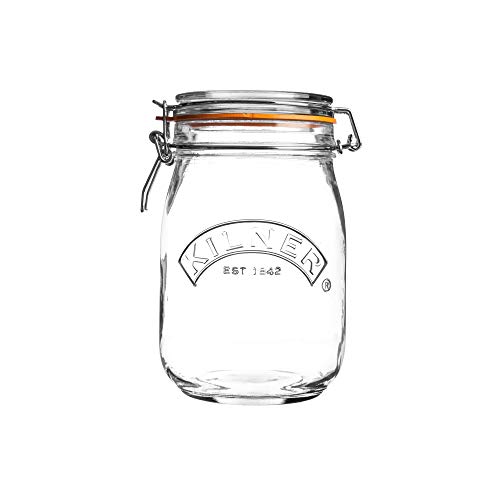
Kilner Clip Top Glass Jar 1L
Kilner
typically £4-5

Pyrex Cook & Store Glass Storage Set (3 Piece)
Pyrex
typically £22-26