Microplastic-Free Baby Weaning Products: UK Parent's Guide
Weaning is one of the most exciting — and messy — milestones in a baby’s first year. It is also a time when your baby’s food comes into prolonged contact with bowls, plates, cups, and utensils, many of which are made from plastics that can shed microparticles into food.
For UK parents who want to reduce their baby’s microplastic exposure during weaning, this guide covers the research, the risks, and the best alternatives available from UK retailers.
Why Weaning Products Matter
During weaning, food is typically served warm or at room temperature in bowls and plates — then scooped, poked, and thrown by enthusiastic little hands. Plastic weaning products endure repeated heating, washing, scraping with utensils, and dishwasher cycles — all of which accelerate microplastic shedding.
Research published in Environmental Science & Technology tested plastic food containers and reusable food pouches across everyday usage scenarios. Microwave heating caused the highest release by a distance — up to 4.22 million microplastic and 2.11 billion nanoplastic particles from a single square centimetre of surface in three minutes. Refrigeration and long room-temperature storage released far less, but still ran into millions to billions of particles. The polyethylene pouch shed more than the polypropylene containers, which matters if you reheat baby food in its pouch.
That study is about containers and pouches rather than plates and bowls, and we have not found an equivalent measurement for children’s tableware specifically — so we are not going to quote one. What it does establish is the principle that runs through weaning: the more heat a plastic food surface sees, the more it sheds.
Melamine tableware is a separate problem worth naming here, because it is easy to conflate the two. Melamine-formaldehyde resin — the binder in most melamine and “bamboo” children’s plates — can migrate melamine and formaldehyde into food at higher temperatures. That is chemical migration, not microplastic particle release. It is a different mechanism with a different evidence base, and it is its own reason to keep hot food off those plates.
Material Guide for Weaning Products
Glass (Best for Microplastic Avoidance)
Tempered glass bowls, and the glass body of storage containers, won’t shed microplastics (container lids are usually plastic, so keep food off them). They are heavier than plastic (a concern for dropping) but can be used with suction bases to keep them on the highchair tray. Brands like Duralex make tempered glass that is 2.5x more resistant to breakage than ordinary glass. The Duralex Lys stackable bowl set is available from Amazon UK.
Stainless Steel (Excellent)
Stainless steel bowls, plates, and cups are durable, lightweight for their strength, and have no plastic food-contact surface. They are drop-resistant (they may dent but will not shatter) and are dishwasher safe. Look for food-grade 304 stainless steel.
Silicone (Lower concern, caveats)
Silicone bibs, mats, and suction bowls are extremely popular for weaning. Silicone is technically a synthetic polymer, but it does not break down into microplastics the way conventional plastics do. Current research suggests silicone is inert and does not shed particles under normal use conditions. We rate it “lower concern, caveats.”
Bamboo Composite (Varies)
Bamboo tableware often uses melamine-formaldehyde resin as a binding agent. While marketed as “natural,” the binding agent is a synthetic compound, and it can migrate melamine and formaldehyde into food — particularly hot or acidic food. To be clear about what that is: chemical migration, not microplastic particle release. Different mechanism, same conclusion. Look for products that disclose their binding agent, or choose bamboo bound with natural resin instead.
Polypropylene (Concern identified)
Standard plastic weaning products are typically polypropylene. The best-measured microplastic release from polypropylene food contact comes from heating, and microwaving is by far the worst case. This is the material to avoid for anything that will hold warm food.
Our Top Picks
Best Weaning Bowl: Glass bowl with silicone suction base
A tempered glass bowl mounted on a silicone suction base combines microplastic-free food contact with the practical benefit of staying stuck to the highchair tray. Several brands offer this combination.
Best Cup: A small stainless steel open cup
Open-cup drinking from around 4-6 months is the right approach — it avoids the spouted sippy cups that are almost always polypropylene, and it is better for oral development. The question is what the cup itself is made of.
We previously recommended the Babycup First Cup here and described it as Tritan. Both halves of that were wrong, and we have corrected them. Babycup states its cups are polypropylene with an EcoPure additive — not Tritan — and polypropylene is the single best-documented microplastic-shedding plastic in food contact, especially under heat. On our own criteria a polypropylene cup cannot be the best cup on a microplastic-free site, so we have re-rated it Concern identified and it is no longer our pick. It remains a perfectly good shape of cup; it is the material we object to.
For the same drinking style without the plastic, use a small stainless steel tumbler. Little Steelie Kids Stainless Steel Open Cups (set of three, 230ml) are exactly this: plain steel open cups with no lid, spout, or liner. A small unbreakable steel tumbler from any kitchenware shop does the same job.
Best Cutlery: Stainless steel baby spoons
Small stainless steel spoons designed for babies are available from brands like Munchkin (stainless range) and can also be found in most UK kitchenware shops. Avoid plastic-handled versions where possible.
Best Bib: Silicone catch bib
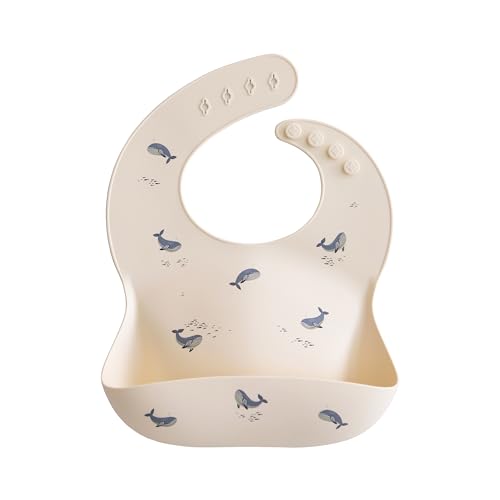
Silicone bibs with a food-catching pocket (like the Mushie silicone bib) are easy to clean and rated “lower concern, caveats”. They replace fabric bibs that need frequent washing and plastic bibs that can shed particles.
Buy the Mushie Silicone Baby Bib on Amazon UK
Practical Tips
- Store baby food in glass containers — Pyrex-style containers with glass bodies are ideal for batch-cooking and freezing baby food. Buy the Pyrex Cook & Store glass set on Amazon UK
- Avoid microwaving in plastic — transfer to a glass or ceramic bowl before heating
- Replace scratched plastic items — scratched surfaces shed more microplastics
- Choose plain colours over printed — printed designs on plastic tableware may use additional synthetic compounds
- Use a silicone placemat rather than placing food directly on a plastic highchair tray
Sources
- Assessing the Release of Microplastics and Nanoplastics from Plastic Containers and Reusable Food Pouches: Implications for Human Health — Environmental Science & Technology, 2023
Recommended Products

Philips Avent Natural Response Glass Baby Bottle 240ml
Philips Avent
typically £10-16
Babycup Sippeco Mini Open Cups (Set of 4)
Babycup
typically £9-12

Green People Organic Babies Baby Wash & Shampoo
Green People
typically £8-14

bamboo bamboo Baby Suction Bowl Set
bamboo bamboo
typically £18-22

Sophie la Girafe Teething Toy
Sophie la Girafe
typically £12-18