Best Microplastic-Free Sunscreen UK 2026
Sunscreen is one of the most important skincare products — dermatologists universally recommend it for skin cancer prevention. But many conventional sunscreens contain synthetic polymer ingredients that environmental organisations classify as microplastics. These polymers wash off in the shower, at the beach, and in swimming pools, entering waterways.
The good news: effective, high-SPF sunscreens exist that use mineral UV filters and natural ingredients without synthetic polymers. Here is what UK consumers need to know.
Microplastics in Conventional Sunscreens
According to research by the Plastic Soup Foundation’s Beat the Microbead campaign, up to 87% of sunscreens tested contained at least one synthetic polymer ingredient. Common culprits include:
- Acrylates copolymer — a film-forming polymer that creates a waterproof barrier
- Carbomer — a thickening agent (polyacrylic acid)
- Polyethylene glycol (PEG) — an emulsifier and humectant
- Dimethicone — a silicone polymer used for skin feel
- VP/eicosene copolymer — a film former for water resistance
These ingredients serve functional purposes — particularly water resistance — but natural alternatives exist. The polymers themselves are not the UV-protective ingredients; they are formula helpers.
Mineral vs Chemical Sunscreens
There are two types of UV filter:
Mineral (physical) filters — zinc oxide and titanium dioxide sit on the skin surface and reflect UV radiation. These are inorganic minerals, not polymers, and do not contribute to microplastic pollution. They provide broad-spectrum UVA+UVB protection.
Chemical (organic) filters — oxybenzone, avobenzone, octinoxate, and others are absorbed into the skin and convert UV radiation to heat. While these chemicals themselves are not microplastics, they are often formulated with synthetic polymer carriers and film-forming agents that are.
Mineral sunscreens are inherently more compatible with a microplastic-free approach because they rely on simple mineral particles rather than complex polymer formulations for their protective function.
Our Top Picks for the UK
Best Mineral Pick: Odylique Natural Sun Screen SPF30
Odylique uses zinc oxide as the sole UV filter with organic olive oil and shea butter. Minimal ingredients, no synthetic polymers, no nano-particles. The formula is thicker than conventional sunscreens — typical of zinc-based formulations — but blends well with a few seconds of rubbing. Available from Odylique’s UK website and selected health food shops.
A Correction: Green People Scent Free Sun Lotion SPF30
We previously described this lotion as a mineral sunscreen. That was wrong, and worth saying plainly: Green People’s own published ingredient list shows synthetic organic UV filters — diethylhexyl butamido triazone and diethylamino hydroxybenzoyl hexyl benzoate — not zinc oxide or titanium dioxide, alongside organic plant oils and polymeric emulsifiers (polyhydroxystearic acid, polyglyceryl-3 polyricinoleate) whose microplastic classification is debated. It remains a far simpler formulation than mainstream sunscreens and we rate it lower concern, caveats, but it is not a mineral sunscreen. Available from Holland & Barrett and Amazon UK.
Best Budget: Altruist Dermatologist Sunscreen SPF50
Altruist is a UK brand created by a dermatologist. While not entirely free from synthetic ingredients, its formulation is significantly simpler than most mainstream sunscreens. Available from Amazon UK at a very competitive price point. Check the specific ingredients list, as formulations may vary by product line.
The White Cast Issue
The main consumer complaint about mineral sunscreens is the white cast — zinc oxide and titanium dioxide are white minerals that can leave a visible residue on the skin. Modern formulations address this in several ways:
- Tinted versions — some brands offer tinted mineral sunscreens that blend with skin tones
- Micronised (not nano) particles — smaller particle sizes reduce visible white cast while remaining above the nano threshold
- Better carrier formulations — natural oils and butters help the minerals blend more smoothly
For darker skin tones, the white cast issue is more pronounced. Look specifically for tinted mineral sunscreens or brands that test across skin tones.
Application Tips
Mineral sunscreens work differently from chemical ones:
- They are effective immediately upon application (no 20-minute wait)
- They sit on the skin rather than being absorbed into it
- They need to be reapplied after swimming or sweating, just like chemical sunscreens
- They may feel slightly thicker — apply in thin layers for better coverage
Sources
- Beat the Microbead sunscreen research — Plastic Soup Foundation
- British Association of Dermatologists sun protection guidance — BAD
Recommended Products
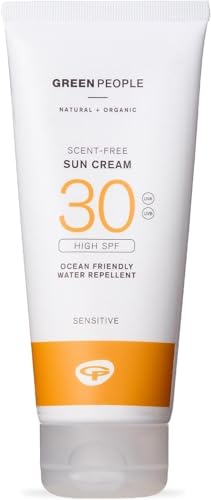
Green People Scent Free Sun Lotion SPF30
Green People
typically £15-25

Weleda Skin Food Original
Weleda
typically £12-17

UpCircle Face Moisturiser with Vitamin E
UpCircle
typically £14-20

Faith in Nature Lavender & Geranium Shampoo
Faith in Nature
typically £4-7

Dr. Bronner's Pure-Castile Liquid Soap
Dr. Bronner's
typically £15-20